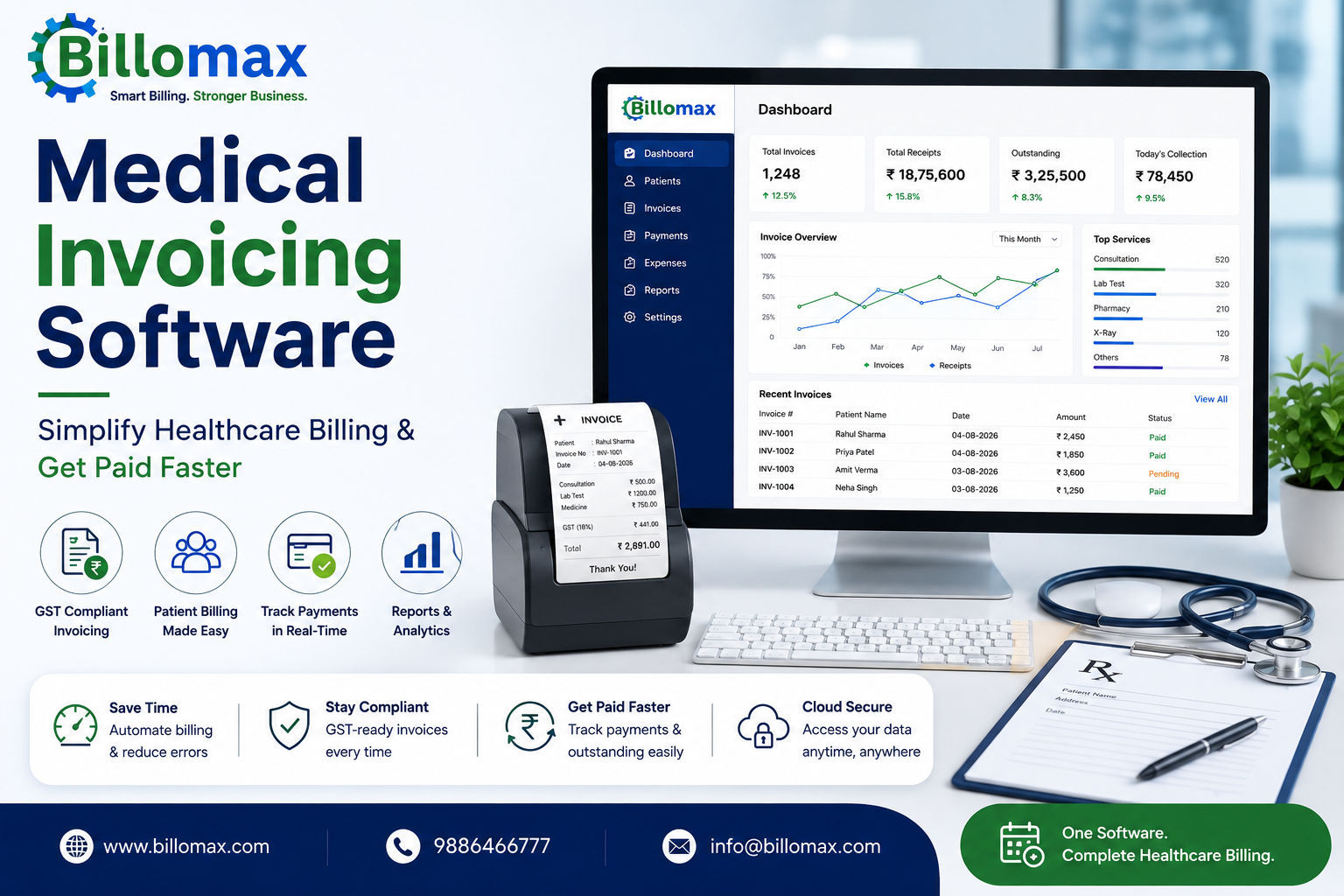
Medical Invoicing Software: Simplify Healthcare Billing & Get Paid Faster
Managing patient invoices, consultation fees, pharmacy bills, laboratory charges, insurance claims, and GST compliance manually can be overwhelming for healthcare providers. Whether you operate a clinic, hospital, diagnostic center, or multi-specialty healthcare facility, accurate billing is essential for maintaining financial health and delivering a seamless patient experience.
Modern Medical Invoicing Software simplifies the entire billing process by automating invoice generation, payment tracking, tax calculations, and reporting. Instead of relying on spreadsheets or paper records, healthcare organizations can manage every financial transaction from one secure platform.
This guide explains what medical invoicing software is, its benefits, essential features, and how to choose the right solution for your healthcare practice.
Table of Contents
- What is Medical Invoicing Software?
- Why Healthcare Providers Need Medical Invoicing Software
- Benefits of Medical Invoicing Software
- Key Features
- Medical Invoicing Software vs Manual Billing
- Industries That Benefit
- How to Choose the Right Software
- Why Cloud-Based Medical Invoicing Matters
- Best Practices
- Conclusion
- Frequently Asked Questions
What is Medical Invoicing Software?
Medical Invoicing Software is a digital solution designed to automate billing and payment management for healthcare providers. It enables hospitals, clinics, diagnostic centers, pharmacies, and medical practices to generate professional invoices, record patient payments, manage outstanding balances, and create financial reports from a centralized dashboard.
Modern systems often integrate with Medical Billing Software, allowing organizations to manage consultations, procedures, pharmacy sales, laboratory services, insurance claims, and GST-compliant invoices within a single workflow. Healthcare billing platforms increasingly combine billing with practice management and financial reporting to reduce administrative effort.
Why Healthcare Providers Need Medical Invoicing Software
Healthcare billing is more complex than standard retail invoicing. A single patient may receive services from multiple departments, including consultation, pharmacy, diagnostics, radiology, and inpatient care.
Manual processes can lead to:
- Incorrect invoices
- Billing delays
- Lost payment records
- Insurance claim errors
- Duplicate billing
- Revenue leakage
- Poor patient experience
Using Healthcare Invoicing Software helps automate these processes, ensuring every charge is captured accurately and invoices are generated quickly.
Benefits of Medical Invoicing Software
Faster Invoice Generation
Generate professional invoices within seconds for consultations, diagnostics, pharmacy purchases, surgeries, and inpatient services.
Improved Billing Accuracy
Automated calculations reduce human errors while ensuring accurate patient billing.
Simplified GST Compliance
Automatically generate GST-compliant invoices and maintain tax-ready financial records.
Better Payment Tracking
Monitor paid invoices, pending balances, insurance settlements, refunds, and outstanding payments in real time.
Insurance & TPA Support
Many healthcare billing platforms support insurance claims and third-party administrator (TPA) billing, helping hospitals streamline reimbursement workflows.
Improved Patient Experience
Quick billing and multiple payment options reduce waiting time and improve satisfaction.
Key Features of Medical Invoicing Software
Patient Invoice Management
Create professional invoices for consultations, procedures, pharmacy purchases, diagnostics, admissions, and follow-up visits.
Medical Billing Software Integration
Connect patient records, appointments, prescriptions, pharmacy billing, and diagnostics into one centralized billing system.
Hospital Billing Software Features
Hospitals require unified billing across OPD, IPD, laboratory, radiology, pharmacy, and surgery departments. Modern hospital billing systems integrate these services into a single patient invoice while supporting GST and insurance workflows.
Clinic Billing Software
Private clinics benefit from appointment billing, consultation invoices, patient history, digital receipts, and payment reminders.
Patient Billing Software
Maintain detailed patient payment histories, outstanding balances, receipts, refunds, and billing statements.
Reports & Analytics
Generate:
- Daily Revenue Reports
- Department-wise Reports
- Doctor-wise Collections
- GST Reports
- Outstanding Payments
- Insurance Claim Reports
- Financial Summaries
Cloud Access
Cloud deployment enables secure access from multiple devices, automatic backups, and centralized management for multi-location healthcare organizations.
Medical Invoicing Software vs Manual Billing
Who Can Use Medical Invoicing Software?
This software is suitable for:
- Hospitals
- Multi-specialty Clinics
- Private Clinics
- Diagnostic Centers
- Medical Laboratories
- Dental Clinics
- Physiotherapy Centers
- Pharmacies
- Day Care Centers
- Healthcare Chains
How to Choose the Right Medical Invoicing Software
Before selecting software, evaluate the following:
Ease of Use
Choose a system with a simple dashboard that requires minimal staff training.
Billing Automation
Ensure invoices, GST calculations, and receipts are generated automatically.
Insurance Support
Look for insurance claim tracking and TPA billing capabilities if your organization serves insured patients.
Reporting
The software should generate comprehensive financial and operational reports.
Cloud Technology
Cloud-based systems improve accessibility, data security, and disaster recovery.
Data Security
Patient financial information should be protected with secure access controls and regular backups.
Why Cloud-Based Medical Invoicing Software is the Future
Healthcare providers increasingly prefer cloud-based systems because they offer:
- Remote access
- Automatic backups
- Multi-location support
- Secure data storage
- Faster software updates
- Better collaboration
- Reduced IT costs
Cloud technology also helps practices scale as they grow without investing in expensive infrastructure.
Best Practices for Medical Invoicing
To maximize efficiency:
- Keep patient records updated.
- Verify insurance information before billing.
- Review outstanding balances regularly.
- Generate daily financial reports.
- Reconcile payments every day.
- Train billing staff on software usage.
- Maintain secure backups.
- Monitor department-wise revenue.
Conclusion
Modern Medical Invoicing Software has become an essential solution for healthcare providers seeking faster billing, improved accuracy, and better financial management. From patient invoices and GST compliance to insurance claim support and real-time reporting, the right platform simplifies administrative tasks and enhances operational efficiency.
Healthcare organizations looking to modernize their billing process should choose a secure, scalable solution that integrates invoicing, patient records, reporting, and cloud access into one platform.
FAQ’S
1. What is Medical Invoicing Software?
Medical Invoicing Software helps healthcare providers automate patient billing, invoice generation, payment tracking, GST calculations, and financial reporting.
2. Who should use Medical Invoicing Software?
Hospitals, clinics, diagnostic centers, pharmacies, laboratories, dental clinics, physiotherapy centers, and healthcare organizations can benefit from it.
3. Does Medical Invoicing Software support GST?
Yes. Most modern solutions generate GST-compliant invoices and tax reports automatically.
4. Can Medical Invoicing Software handle insurance billing?
Many platforms support insurance claims, TPA billing, and reimbursement workflows for healthcare providers.
5. Is cloud-based Medical Invoicing Software secure?
Yes. Reputable cloud-based platforms provide encrypted storage, automatic backups, role-based access, and secure remote access to protect patient and financial data.
Comments (0)
Be the first to share your thoughts on this post.